Sunday, May 23, 2010

A Lazy Sunday - Side Trips To Great Yarmouth & Lowestoft

It was a slow morning going down for breakfast at 8:45, updating the family tree on ancestry.co.uk and then taking a leisurely walk over to and up Station Road to the train station - this time the one going to Norwich.  Station Road was crowded with people wandering down to the beach.  This weekend has been the “Cromer & Sheringham Crab & Lobster Festival” with the streets and beaches crowded with holiday-goers.  The sun was shining brightly with only a few clouds in the sky.  It was a bright sunny early summer day.  My objective was to travel by train from Norwich out to Great Yarmouth and Lowestoft located at the top end of the English Channel.  I was curious to find out why the goal of the railway lines in this area was to reach these two towns. 

I boarded the 10:45 train to Norwich and watched the countryside go by as we sped first to Cromer and then on to Norwich.  There were fatted bunny rabbits in the fields, sticking their heads out above the grass looking at the train as we went by. What!!??  I wouldn’t have believed it if I hadn’t seen it!. 

Arriving at Norwich station, I bought a “Roamer” ticket for £4.90 which gave me unlimited travel for the day between Norwich, Lowestoft and Great Yarmouth.  As I had an hour to wait, I bought a sandwich and drink, sat down, and started my blog for the day.  British train stations are built with tall arched roofs that are open at the train end to the elements.  The roofing material is glass which allowed the sun to stream through the station making it a nice hot sunny day. 

I caught the 12:45 train to Great Yarmouth arriving at 13:20.  The area between Norwich and Great Yarmouth is on a large marshy flood plain that has been recovered from the sea.  The area is simply referred to as "The Broads" because it is a very broad flat expanse of marshy farmland.  Everywhere you look there are vast expanses of treeless flat land with ditches running in every direction.  Dotted throughout the countryside are strategically located wind mills from a couple of centuries ago that pumped the water from the field ditches into higher and wider central ditches and ultimately into a larger ditch that dumped the fresh water into the ocean.

Herds of beef cattle with the calves trailing behind their mothers, flocks of sheep with a couple of lambs in tow, horses rolling in the grass, swans nesting alongside the ditches or on the water with a couple of signets floating behind - everywhere you looked there were flocks of animals grazing. 

And here I thought it was only the Dutch who had reclaimed land from the sea!  I don’t know who thought of the idea first - the Dutch or the English - but there was a great similarity between the windmills of these two countries.  The windmills have long since been replaced with electric pumps but the volume of water is such that these large canal-like or river-like ditches make great places for boaters of all sizes and stripes, er, sails.  I could see groups of sea-kayaks making their way along these water bodies.  The train sped through the middle of these reclaimed marshes on its way to Great Yarmouth.   

Immediately on arriving, the train returned to Norwich for 13:55.  The next leg of my journey was to then take the train to Lowestoft which left at 14:55.  Boarding the train to Lowestoft, we travelled along the same kind of countryside only the fields were much broader with more expanses of water. 

The train hit a bunch of slow signals and two iron swing bridges with slow speed limits.  As a result, we arrived at 15:55 instead of 15:40 just in time to see a train pulling out of the Lowestoft station.  I sat on my train, expecting it to return to Norwich.  In a couple of minutes the conductor announced that this train was going to Ipswitch - way far away from Norwich and Sheringham!.  The train that had been pulling out as we arrived was my return train.  And because my train was late in arriving, I had missed my return trip back to Norwich.  The next train back didn’t leave for another two hours. 

This gave me a chance to walk around the corner into the middle of town, take a quick look at the beach, amusement pier, the fishing and shipping docks.  Lowestoft was one of those ubiquitous British seaside holiday towns where every Brit flocked to each summer.  Which is one reason why the railway lines were built in this part of the country. 

Being as it was close to supper, I had to have a plate of sea bass, fresh baby field potatoes, green peas, along with a pint of Guiness while I updated my blog on the patio of the Harbour Hotel overlooking the top end of the English Channel.  Life is difficult, ain't it?

As the train left Lowestoft, I saw a bunch of abandoned railway sidings.  These once held the fish vans (rail cars) that, in the mid 1850s to early 1950's, transported the day's catch from both of these towns on fast through trains down to London.  The fish landed on the Londoners' dinner plates as fresh as could be - less than 24 hours from being pulled from the sea. The fishing fleet has been much reduced since then and most of the fishing boats are big ones. 

I arrived back in Norwich at 18:33 with the train to Sheringham standing on the next platform.  I hopped on board and at 18:36 my train pulled out!  Not a minute to spare.  The trip back to Sheringham was very fast with the usual 100 fatted bunny rabbits hopping around the common as the train pulled into the station.  A leisurely walk down to the beach, along the top of the walk, a climb up the stairs and the walk, and I was back at my B&B. 

We’re off to Oxted tomorrow to look at the Bicknell side of the family.

Saturday, May 22, 2010

Exploring The Family Roots On-Line; Hints On Solving Some Mysteries?

My intention for Saturday was to pick up my book on the history of Letheringsett, scan the pages that listed the residences on Blakeney Road so that I could locate where my great-great grandparents lived back in 1851.  Unfortunately, the book was still in transit from the lending library and hadn't yet arrived.  So that was the end of Plan A. 

I then had to resort to Plan B which wasn't quite formulated in my mind yet.  I spent the next 21/2 hours cruising the Norfolk Family History website (another excellent source of information for us genealogists) to see information they had on-line.  I learned quite a bit about the history of Letheringsett and the location of the farms of Lord Thomas Hardy who my forebears had worked for.  It seems that he also had a farm, Glandford Farm, which was about 1 1/2 miles south of Letheringsett in another parish. (The green balloon with "NHE" on it marks the site.  Note the proximity of the railway line in the bottom right corner of the map - which may be why I've got the trains in my blood!!??)

One has to understand the importance of parishes in England.  For purposes of civic administration - before there were any civic administrations we call municipalities - England was divided into parishes with a Church of England at the centre of the parish (figuratively, that is).  Much like a township boundary, the parish boundary decided which church you would be baptized and married in.  In the days when there were no registry offices to register births, marriages, and deaths, the church in each parish was responsible for recording these events in a book - the parish register.

Each year in March, the parish priest (they're called priests in the Church of England and Anglican Church of Canada) sent a copy of the parish register to the local bishop who had his archdeacons collate this information into one diocesen register (a group of parishes are contained within a diocese with a bishop in charge of the diocese).  So, when one is researching the family roots, one has to know which parish one's ancestors came from as it makes the search that much easier.

Census records and other historical records are also organized on the lines of the parish so it helps if one knows the physical boundaries of the parish and whether one's ancestors lived in the parish boundaries of Letheringsett with Glanford and worked in the parish boundaries of Thornage (the parish next to Letheringsett with Glanford). (which is not the same location of Glandford Farm).  At least that's what the Norfolk Heritage Explorer website says. 

Anyhooo..... the long and the short of it was that I got a good lesson on the importance of parishes at the library this morning and perhaps a solution to the mystery of why I can't find the residence of my great-great-great grandmother, Sarah Moore (nee Page), after her husband (my great-great-great grandfather), Stephen Moore, was killed on 01 November 1804.  Cause she may have been living in Little Thornage which is the next parish over. 

Curiosity also got the better of me as I was exploring the Norfolk Heritage Explorer website so I did a search on Letheringsett.  108 items came up on the search so I started to browse a few of them.  To my surprise, a couple of Bronze Age (1,000 - 1,600 BC) ring ditches came up just down the laneway from where Stephen Moore's Pit Hole is located.  I may take a trek up the hill the next time to see if I can locate them.  (The two green balloons marked "NHE" are the location of the ring ditches.  The yellow balloon marked SMPH is the site of Stephen's pit.)

After browsing the Internet at the library, I made my way over to the station just as the Class 31 diesel was coming into Sheringham station. 

I made my way up to Weybourne shops to browse the M&GN book store.  I ended up buying a few books and early newsletters of the railway to read later in the weekend.  It was a nice sunny day that had now burned the fog off with a cool breeze coming in off the North Sea.  The shops were all locked up but I managed to get inside to do a bit of painting.  In between, I managed to take some photos of the steam locomotives that were under maintenance or overhaul.

I returned back to Sheringham and cruised the shops.  There are quite a few small butcher shops that sell some beautiful looking meat.  One shop had some prawn, shrimp, and crayfish baguettes.  So I picked up two along with a bottle of pear & apple juice, made my way up cliff road, down to the top of the cliffs and ate my supper on one of the benches overlooking the beach and the North Sea.  A gentleman came along, saw my "Canada" name tag and we started a conversation.  He was as interested in world politics as I and we must have chatted for a good 20 minutes.

Tomorrow I think I'll do some exploring of Norfolk by train - down to Norwich, over to Great Yarmouth and Lewiston and back.  Might be interesting to see what "The Broads" (the marshy land with lakes) look like.

Friday, May 21, 2010

Chasing Family Roots - It Leaves You In Awe Looking At 200-Year Old Records!

I was up and downstairs for breakfast for 8:10 as I wanted to do some on-line research for the family roots on www.ancestry.co.uk.  The information would determine whether I went to Letheringsett to find former residences, or whether I went to Norwich to look at county and parish records.  I then swung by the library to see if my book was in (no luck) and sat down at one of their computers to find direction maps of how to get to the records office in Norwich and to further search for information on my ancestry.co.uk website.  (If you want to take a look at the info, send me an e-mail off-line (family members only)).  Upon scanning through the information and doing some research on Google maps, it was off to Norwich for the day.

I left the library, walked up the street to the train station - the one that goes to Norwich - in time to see the 10:45 arriving at the station.  The station platform was full of people getting off and getting on the train. Train service in Britain is very civilized with a frequency of every 30-45 minutes even late into the evening.  I got on the train and sat down to enjoy the trip.  The guard (conductor) came along. The fare, Sheringham to Norfolk and return was only £4.15 with my Seniors Rail Card!.

I had previously picked up a book about the railway lines in the Sheringham-Cromer area which I had been reading with great enthusiasm.  As the train travelled along, I had a better understanding and appreciation for the little towns and villages that I was passing and how the railway fit into the lives and history of these communities.

I arrived promptly at 11:35 at Norwich station.  It was a 30 minute walk to the Norfolk County Archives - mostly uphill.  After getting instructions on how to find what I was looking for, by 12:30 I was sitting at a microfilm reader, cruising the microfilm at a mile-a-minute and writing the notes into my baby laptop.

Actually it was more like frame-by-frame trying to decipher the white-on-black negative that had been originally written in old vellum note books more than 200 years ago - 1676 to 1841.  On some pages the microfilming wasn’t the best quality.  It was impossible to discern the names before 1777 which is the period that I was particularly interested in.  Working forward from 1777, I was able to pick up tons of information on my great-great-great grandparents and their children, and my great-great-grandparents and their children.  Before I knew it, the clock struck 5:00 pm and it was time to leave.   I had a full two pages of notes from the microfilm.  I have to go back again next week to get photocopies of the relevant records and to take a look at other parish records.

I walked back towards the train station but, because I had an off-peak ticket, I had an hour to kill before boarding the train.  In the morning, I had seen the sign for a fishing gear store, “The Compleat Fisherman”, nestled right alongside the river that flows through the city.  So, I wandered over to take a look at how fishing was done in this neck of the woods.  Turns out the “Compleat Fisherman” is an old-fashioned pub. That required having a brew-or-two and a jacket-potato with beans while waiting for the train.

As we approached Sheringham and the North Sea coast, a fog as thick as pea soup had rolled in. I could hardly see the shores.  Perfect weather, though, for 100 fatted bunny rabbits hopping all over the common as we came into Sheringham.

Thursday, May 20, 2010

A Closer Look at Black Five; Shunting Around The Yard

Thursday morning was a very lazy day, missing the 10:30 train just steaming away and waiting for the DRB to come down from Weybourne.  On my way to the station, I had made my usual side trip to the library to see if my reserved book, “A History of Letheringsett 1769 - 1818” by Lord Basil Couzens-Hardy published in 1959 had arrived yet.  I then sat down to see what kind of records were in the County records office in Norwich as I was thinking of taking a trip down to Norwich to scout things out tomorrow.

I started to set up my baby laptop in the carriage sheds so that, as each inspiring thought or event came to mind, I could write up my blog throughout the day. All I then had to do at the end of the day would be some rigourous editing and adding photos instead of trying to remember what went on during the day and thinking about what to say.  I also added photos to my PowerPoint presentation on train derailments in North America to show the lads at tea time.  North American derailments tend to be quite spectacular as the locomotives and equipment are that much larger. 

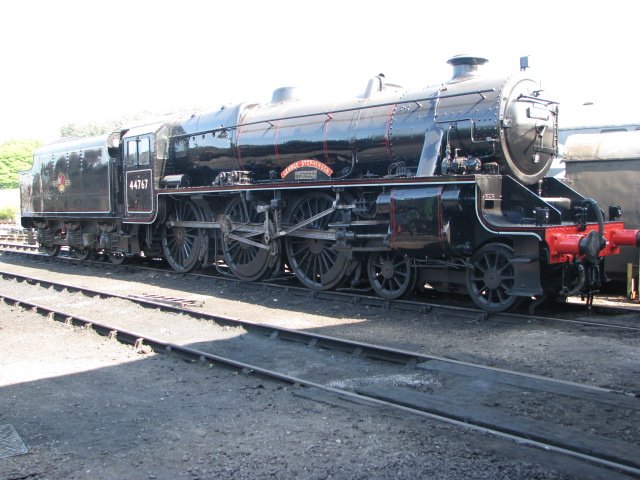
Black Five 4-6-0, "Robert Stephenson", was out in the yard undergoing some minor repairs so Peter and I went down to look the beast over.  It is indeed a real Black Beauty, even if it is an iron horse.

Later in the afternoon, the lads were doing some shunting with the yard switcher, Class 11 #12131, moving 0-6-0 tank engine "Ring Haw" and the N7 0-6-2 #69621 to another track to clear the way to get into the locomotive shed to pull the Class 31 diesel out of the shed to put it on another track, along with the J15 0-6-0 #65462.  This required another look at what was going on. 

As "Ring Haw" and the N7 were pulled out, this gave us a clearer view of Black Five

Once this was all done, the J5  had to be pushed back into the shed.  A bit of switching exercise indeed. 

Peter and I went back to painting some birch plywood panels for the coach that was under complete rebuild.  Peter had to leave at 5:00 but at that point, Nigel and Carol came walking in along with Brian and so we were ready for the evening shift of the Thursday evening volunteers.  While Nigel went for fish-and chips, my favourite 0-6-2T GWR tank engine pulled into the yard after a day of pulling the passenger cars on the line.  I strolled out to take a few pictures and to see how things were done.

 Later that evening, the container flat had to be moved closer to the C&W sheds onto the track behind the BP tank car so a bit more switching was done with the big Class 25 diesel #25057.  As the head shunt wasn't long enough to pull all the cars and wagons back, it took a few extra moves.

We worked until 10 pm with a couple of tea breaks in between when it was time to leave.  While not a particularly busy day, it was a good day to see a lot of switching moves and to get an idea of what the trackwork in the yard looked like.  And, as I have been writing up this blog, I've also had a few extra cups of tea.  Definitely had more tea in the last 7 days than what I've had in the previous 17 years. 

Tuesday, May 18, 2010

Wednesday - Days of WWII, Locos Leaving & Arriving, Another Bright & Sunny Day

In the dark days of WWII when Britain was facing invasion and bombs were dropping on London, children were evacuated without their parents to the smaller centres of the country.  As part of their education events, the NNR, in cooperation with the schools, is visited by school kids of all ages for a re-enactment of those days and what the youngsters of the day went through.  When I arrived at Sheringham station, a “matron” and a “general” dressed in World War II uniforms were talking to some visiting seniors.  So I took their photo.

World War II Days are very popular on steam preservation railways.  Visitors and volunteers don period costume to recreate this most memorable period in British history.  These events even include “German invaders” who capture a train station that has to be recaptured. 

As I walked down the end of the station platform, Andy and Bob were having their tea break.  As I began talking to them, #5619 was pulling into the station - not with a passenger train, because that was on my platform - but with 4-6-2 steam locomotive Battle of Britain 92 Squadron #34081.  The loco was in the process of being shipped permanently off the NNR down south.  The station switcher, diesel #D2063, with passenger coach attached, coupled up to the 4-6-2 and pulled it up and onto a siding where it was going to be loaded onto a lorry (tractor-trailer float).  While at the NNR, the 4-6-2 developed major problems requiring a major overhaul.  The owning group couldn’t raise the funds for the overhaul so arrangements were being made to send it to another steam preservation railway down south. 

While I was photographing these movements, the general and the matron, along with an air raid warden, trooped by with a class of school children.  The kids were dressed in period costumes - at least to the extent that they could find old clothes.  In preparation for this trip, they had prepared large name tags with their names on them, and cardboard boxes marked “gas mask”.  Instructions were given by the matron and the general as to the do’s-and-don’ts when on the railway and if the train should be attacked, much the same as during those days of WWII.  . 

They would be travelling up to the end of the line at Holt to the NNR's Education Centre for a day of instruction and replication of what their grandparents went through during the days of WWII.  In addition to the history lesson, they would learn how to don their gas masks, the importance of air raid warnings, and how to scramble into the air raid shelters.  And they would have the joy of eating spam for breakfast, lunch, and dinner (no peanut butter and jam back in those days!) (okay, so the kids would only be eating spam for lunch as they would be back home in time for dinner). 

These are regular events on the NNR as teaching the history of WWII is part of the British school curriculum.  The NNR fits quite nicely into this part of their history. 

Before the 4-6-2 came down from Weybourne sheds, the lorry had delivered Black Five 4-6-0 #44767 with her tender still to be unloaded and put on the tracks.  Steam locos are readily loaded onto lorries and trucked all over the country from steam preservation railway to steam preservation railway. 

I arrived at Weybourne at my usual 10:45 to meet new volunteers, Malcolm and Sylvia, along with Mike who I had met the week before.  Each person was working away on their assigned tasks, the sum of which would result in the ultimate restoration of a piece of historic rolling stock.  This was a case where Mike wire brushing the rust off of some steel brackets, Sylvia brushing on some rust remover to the steel brackets, Malcolm painting some 1/4” plywood for a coach, and me working away sanding, counter-sinking, drilling, priming and painting a strip of wood 2”x 1/4”x 6’would result in the overall restoration of a coach or coaches. 

I had the piece of teak wood trim sanded, countersunk, drilled, and the first coat of primer put on by 13:00, at which time, it was time for lunch. 

Black Five 4-6-0 #44767 arrived at Weybourne in time for tea at 3 pm hauled by the Class 37 diesel, so this required a close look-see by all concerned.  Here’s Mike and AndrĂ© reluctantly posing for their photo. 

Back to Sheringham by 5:30 in time to get a bit of laundry done and to write up the blog before hitting the hay. 

Tuesday At The Shops - Meeting More of the Guys

It seems as if I've now settled into a regular routine here in Sheringham.  Up in time for breakfast at 8:15, read my e-mail, update the blog, wander over to the library just in time to miss the 9:45 train up to Weybourne.  But that's okay 'cause the 9:45 train is the diesel and I prefer to catch the 10:15 train 'cause that one's my 0-6-2T Great Western Railway steam locomotive.  The guys on the platform are starting to recognize me with their "Going up to Weybourne, eh!?" greeting which doesn't require me to explain that I'm going up to Weybourne and that I won't be paying any fare (volunteers ride for free any time of the week).

Arriving at 10:30, the guys were sitting down for tea.  I signed in but decided I should skip tea and get to work.  There were a whole new crew of volunteers on the job in the C&W shops working on the M&GN brake van - Bernie, John, Mike.  With introductions all around, we all settled back down to work.  I started to pour some paint out of the paint can into a 750 ml plastic container - verrrrryyyyyyy carrrreeeeffffullllyyyyyyy - as I had had the experience, twice no less, of dumping paint onto the floor.  As the guys were working all around the brake van, I decided to put the paint away as any of my paint work would end up on their coveralls.

Bernie was struggling to install the drip edge that I had painted the day before so I gave him a hand.  After we had worked out the easy way to install the drip edge using clamps and wood blocking, things started to move along quite nicely.  With tea-time in the morning and tea-time in the afternoon, lunch tends to be delayed by at least an hour-and-a-half until 1:30 - 2:00.  My stomach has finally started to adjust to this time delay in addition to the time change between EDT and GMT.  Volunteers at Weybourne get sandwiches, drinks, etc for half price at the station buffet so lunch has been costing me about £5.

By the end of the day, Bernie and I had about 1/3rd of the drip edge installed.  The rest will be installed when they return next week.  Or, now that I know how they want it installed, it is probably something I can do myself.

The guys started wrapping things up at 4:15 so I decided to do the same so that I could catch the 4:30 diesel  train back to Sheringham.  As I sat down on the bench in the sun to wait for the diesel, #5619 came steaming up from Sheringham back to the locomotive sheds.  It had to run past me and I took a deep whiff of the steam, coal, and oil smells as she went by.  A nice way to end the day. 

.

Monday, May 17, 2010

Monday - Back At The Shops & A Little Bit Of Family History

On my way to Sheringham station, I stopped into the library to see if they had the Letheringsett history book written in 1959 by Lord Basil Couzens-Hardy. This book is a reprint of the diaries kept by his great-great........-great grandmother from 1759 to 1819 and contains extracts on the death of my great-great-great grandfather, Stephen Moore, in 1801; their farm labourers at various periods of time, including the Moores; and the location of the residences around their main farm on Blakeney Road. This is where my ancestors lived right up until my great grandfather, Edmund Moore, left Letheringsett in 1858 to make his fortune in London Town.

Their copy was shown as “missing” but there were several copies in other libraries including quite a few in the Holt library which is only one mile from Letheringsett.  The librarian made arrangements to have a copy sent to them which I could borrow. From there, I can scan the necessary information.

I then made my way up to Sheringham station to be greeted, once again, by my 0-6-2T GWR tank engine waiting to start its 10:30 trip up to Holt.  There were two classes of young school children who were on a railway outing up to Holt where they would hold classes about World War II and what conditions were like during that period of time for young people.   Steam preservation railways have at least one or two “1940s days” where they recreate the conditions of the World War II, complete with soldiers in period uniforms, rifles, gas masks and vehicles of the era, including tanks, personnel carriers, and the like. The NNR has linked up with a vintage bus group which provides transportation between stations and into the nearby towns.

I continued finishing some painting on the M&GN brake van so I won’t bore you all with the rest of the details. Instead, I will provide you with some Moore family history.

Moore Family
In the mid to late 1970s, my father had managed to trace the family roots from his father, who emigrated to Canada in 1895 from London to his grandfather, Edmund Moore who lived around the corner from St Paul’s Cathedral, back to the little village of Letheringsett where Edmund Moore was born. From there, he managed to get the family tree back to his great-grandfather, Matthew Moore, and his great grandmother, Elizabeth Gidney, his great-great grandfather, Stephen Moore, who was killed by a chunk of clay on November 1st, 1804, and his great-great grandmother, Sarah Page. He found that his great-great--great grandfather was Mark Moore and his great-great-great grandmother was Mary Moore. From there, the history was very sketchy as he didn’t have access to the Internet resources as we have today. While I have been able to find a lot of information on the information, it has to be verified by examining the actual records which I hope to do June 2-3 at the county records in Norwich.

My father was able to determine that his grandfather lived around the corner from St Paul’s Cathedral up until 1871. He was able to locate a painting of their residence at #9 St Andrew’s Hill and obtained a black-and-white photograph of the painting. In 1999 with access to the Guildhall Library’s website, I was able to get colour prints of this painting plus another painting showing the same location (the Guildhall Library is the civic archives for the City of London)..

In 2004, I spent 6 days in London on our way to and from Ghana (3 +3) which included a visit to the London Guildhall Library where I was able to view these two water colours, plus a 3rd which showed the back of their residence. I also was able to find a detailed outline of the area through the insurance maps of the area. Insurance maps, as the names imply, were ordered by fire insurance companies to detail where they had insured properties in case of large-scale fire. They are invaluable in doing historic research.


After 1871, my father lost track of where Edmund Moore lived. Since then, through on-line access to census records, birth-marriage-death records, I have been able to find Edmund Moore’s residences with each of the 10-year census up to 1901 (the 1911 census won’t be released to the public until 2011).


So, that's a little bit of the Moore family history.  If you are interested, it's all being recorded on www.ancestry.co.uk.  You will need a special invitation from me to look at the family trees. 

.